
MLC v. Spotify: The Bundling Fight Isn’t Over, and the Number Keeps Growing
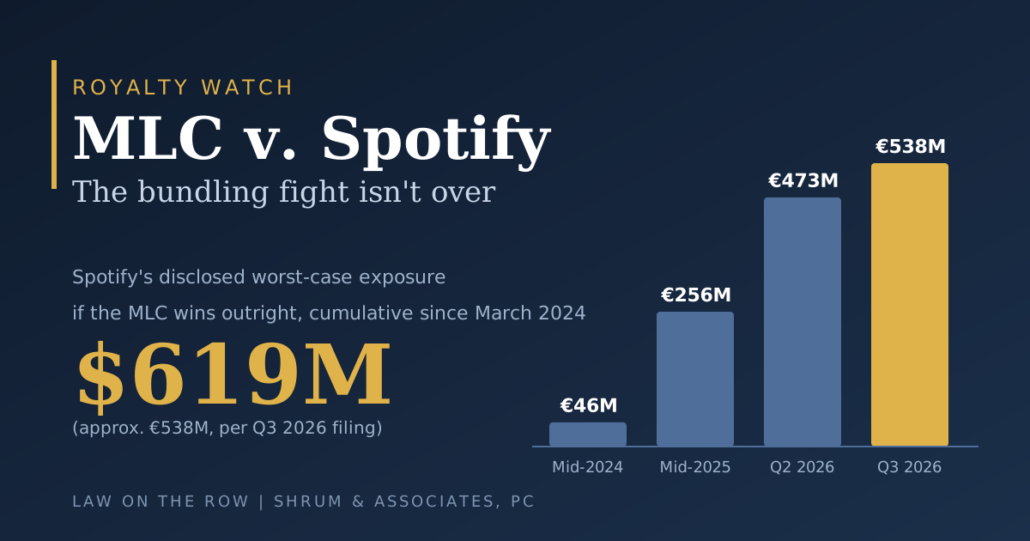
On October 27, Music Business Worldwide reported that Spotify’s own Q3 2026 financial statements put its potential liability in the MLC bundling lawsuit at approximately €538 million, or about $619 million. That is up €65 million from the prior quarter. If you work with songwriters or publishers, that number deserves a careful read, because it does not mean what the headlines may suggest.
Prefer the quick read? Here is the companion piece on Substack: Spotify’s $619 Million Footnote.
The short version
The Mechanical Licensing Collective sued Spotify in May 2024. Starting in March 2024, Spotify began treating its Premium Individual, Duo and Family plans as “Bundled Subscription Offerings” because they now included audiobook access. Under the mechanical rate formula, a bundle reduces the revenue base on which the music royalty is calculated, which means lower payments to publishers and songwriters. The MLC said that was wrong under the Section 115 regulations.
In January 2025, Judge Analisa Torres of the Southern District of New York disagreed with the MLC and dismissed the original complaint. Her reasoning: Premium combines music with another service, audiobook access, that has “more than token value,” and the regulation’s text leaves no ambiguity on that point.
What happened since
The case did not end. The MLC filed an amended complaint on October 1, 2025. Rather than only arguing that Premium cannot be a bundle, it now targets how Spotify valued the pieces of the Premium bundle and how it reported royalties for its Audiobooks Access plan.
The MLC lost its bid for an early appeal. In an order dated September 1, 2026, Judge Torres denied certification of an interlocutory appeal of the bundling ruling, finding no substantial ground for difference of opinion. In practical terms, the “Premium is a bundle” holding stands while the rest of the case proceeds.
Spotify lost a defense. The same order struck Spotify’s “unclean hands” defense, which argued the MLC had not pursued other licensees over similar bundle reporting. The court found no legal basis for it, and rejected the idea that the MLC must enforce Section 115 against everyone in the same way at the same time.
Summary judgment is next. Under a schedule approved October 9, pre-motion letters for summary judgment are due December 11.
Reading the $619 million number correctly
Spotify’s filing says the €538 million figure applies only if the MLC is “entirely successful” in its claim that Premium is not a bundle. The court has already ruled that it is. So that outcome would require the MLC to overturn the ruling on appeal after the rest of the case resolves. The filing also notes that any liability would be partially offset by direct deals with publishers, and that potential penalties and interest cannot be reasonably estimated.
Two things are worth taking from the figure. First, it is a worst-case disclosure measured from March 1, 2024, not a prediction. Second, the trend is notable: the estimate has climbed from €46 million in mid-2024 to €256 million by mid-2025 to €538 million now. Spotify’s filing does not say what drove the latest increase.
Why this matters beyond one lawsuit
Direct deals. Since January 2025, Spotify has signed direct U.S. publishing deals with Universal Music Publishing Group, Warner Chappell, Kobalt, Sony Music Publishing and BMG. For independent publishers and self-published songwriters who rely on the blanket license and the MLC, that is a very different position, and it is the context for why this case matters to the independent community.
Phonorecords V. The bundling dispute has surfaced in the Copyright Royalty Board proceeding that will set mechanical rates for 2028 through 2032. According to reporting, the NMPA and NSAI told the board that Spotify has already taken “more than $500 million” in mechanicals that should have gone to songwriters and publishers. Spotify’s position, stated since the suit began, is that the bundle terms are ones publishers and services agreed to under Phonorecords IV.
Washington is watching. In June 2025, Senators Marsha Blackburn of Tennessee and Ben Ray Luján asked the FTC to examine Spotify’s bundling practices. That is a consumer-protection angle that sits alongside, not inside, the royalty case.
What I’d watch
- The summary judgment letters due December 11. They will show how each side frames the valuation and reporting questions that now drive the case.
- Whether the MLC preserves its bundling appeal. The MLC has said it intends to appeal the bundling order even if it wins the amended case, so the “Premium is a bundle” question is likely headed to the Second Circuit after final judgment.
- Spotify’s next quarterly disclosure, since the contingency figure has moved every quarter.
- Phonorecords V. Whatever happens in court, the rate proceeding may be where bundle treatment is ultimately reset going forward.
Practical takeaways for songwriters, publishers and managers
- Review mechanical statements from Spotify from Q1 2024 forward and understand how bundle treatment affects your line items.
- If you have a direct deal, understand how it interacts with the blanket license for your share.
- Keep your MLC registrations and work data clean, because any eventual recovery runs through accurate claims.
This post is general information about a developing public case, based on public reporting and court filings, and is not legal advice. Case status can change quickly. If you have questions about how this affects your catalog or agreements, contact our office.
Sources
- First Amended Complaint, Mechanical Licensing Collective v. Spotify USA Inc., No. 1:24-cv-03809 (S.D.N.Y.), Dkt. 88 (Oct. 1, 2025)
- Music Business Worldwide, “Spotify’s potential bill if The MLC wins its ‘bundling’ lawsuit outright rises to $619M” (Oct. 27, 2026)
- Hypebot, “Spotify and The MLC Both Score Wins in Latest Royalty Ruling” (Sept. 7, 2026)
- Digital Music News, “Federal Judge Rejects MLC’s Interlocutory Appeal Push” (Sept. 7, 2026)
- Digital Music News, “The MLC Moves to Appeal a Decisive Bundling Win by Spotify” (Nov. 26, 2025)
- The MLC press release (May 16, 2024)
- Music Business Worldwide, “US senators call for FTC probe into Spotify’s bundling practices” (June 2025)
- Court docket (S.D.N.Y.), Dkt. 183 (Sept. 1, 2026 order)


Leave a Reply
Want to join the discussion?Feel free to contribute!